
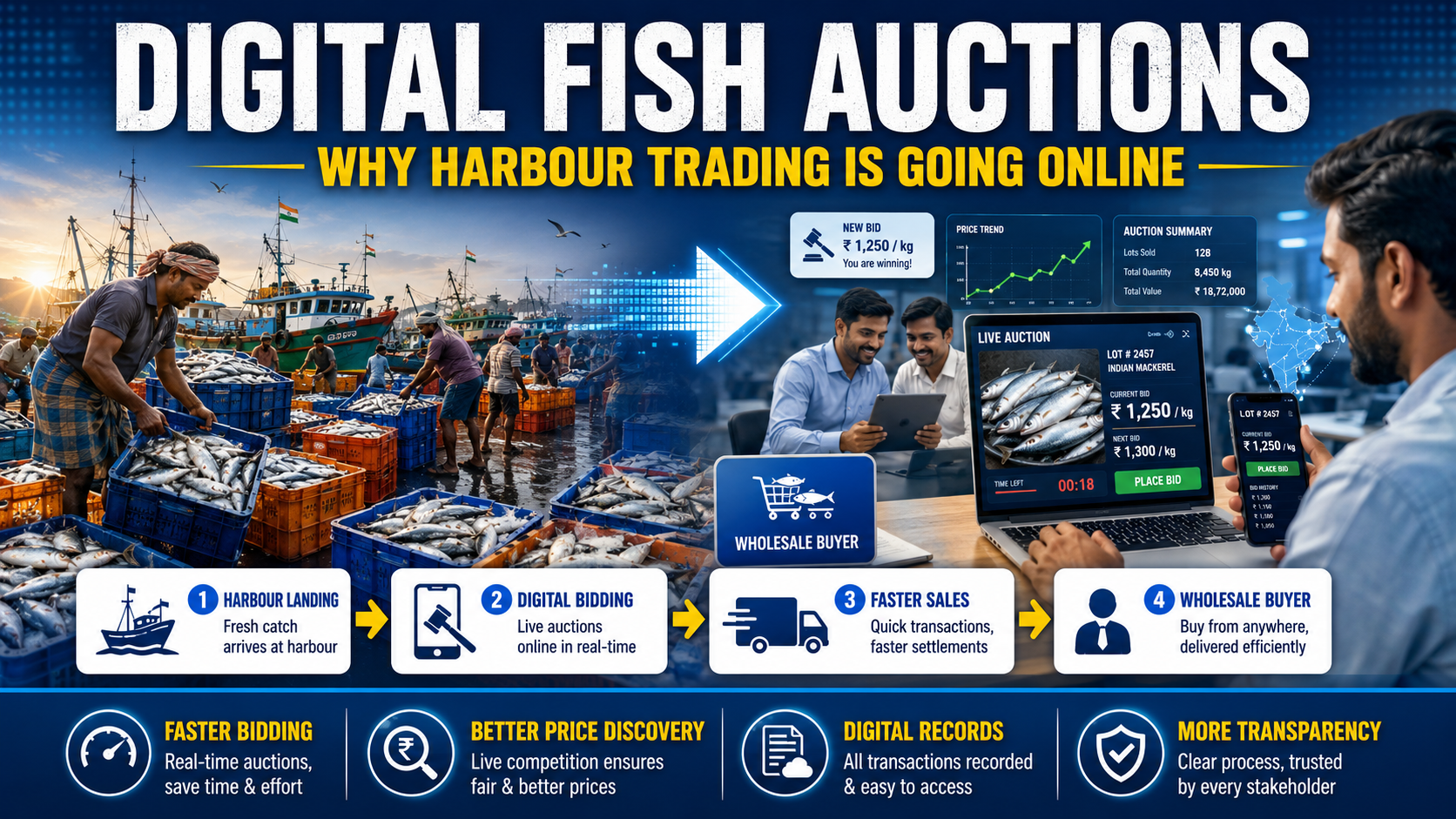
For decades, India's harbour fish trade ran on shouted bids, handwritten chits, and trust between agents who had worked together for years. That system worked — until volume grew, buyers diversified, and disputes over weight and price became too expensive to ignore. Digital auctions are not about replacing the harbour. They are about giving it a record.
How traditional harbour auctions work
When a vessel lands, catch is often displayed in lots on the quay. Commission agents and buyers inspect quality, then bid in an open outcry process. The highest bidder wins. Payment may be cash or credit. Weights are estimated or measured on manual scales. Records, if any, go into notebooks.
This process is fast and culturally familiar. But it lacks audit trails. When a hotel chain asks for proof of purchase price, or a fisherman disputes what he was paid, the notebook is the only evidence — and notebooks disagree.
What digital auctions change
A digital fish auction platform digitises the same workflow without removing human judgment:
- Lot registration — each batch gets a unique ID linked to vessel, species, and weight
- Electronic bidding — registered buyers bid through terminals or mobile devices
- Integrated weighing — certified scales feed weight directly into the system
- Instant invoicing — winner, price, and lot details generate automatically
- Ledger and credit — repeat buyers settle against running accounts with full history
The auction still happens at the harbour, at the speed the trade demands. What changes is that every transaction leaves a timestamped, searchable record.
Benefits for each stakeholder
Fishermen and vessel owners
Transparent pricing reduces the risk of underpayment by intermediaries. When auction results are published, landing prices become visible — helping cooperatives negotiate better and plan future trips based on real market data.
Commission agents
Agents who add genuine value — grading, buyer relationships, logistics — remain essential. Digital systems reduce their administrative burden and protect their reputation when disputes arise, because records are objective.
Wholesale and institutional buyers
Remote bidding lets buyers participate without travelling to every harbour. Grade specifications, lot photos, and historical price data support better procurement decisions. Integration with cold chain logistics closes the loop from bid to delivery.
Regulators and market operators
Licensed marketplaces can report aggregate landing volumes, species mix, and price trends to fisheries departments — supporting stock management and policy decisions without manual surveys.
Technology beyond the auction floor
Modern harbour platforms combine auction software with broader capabilities:
- Computer vision grading — consistent quality assessment across shifts
- Market analytics — price trends by species, size, and season
- Credit management — controlled exposure for high-volume buyers
- Mobile access — harbour staff and buyers operate from any device
BlueHarvest Exchange is building this full stack — explore our Platform & Technology page for the product roadmap, including digital trading launching at platform release.
Challenges of going digital
Adoption is not instant. Harbours face connectivity gaps, varying literacy levels, and resistance from actors who benefit from opacity. Successful rollouts share common traits:
- On-site training during actual landing hours, not classroom sessions
- Parallel operation — paper and digital together for a transition period
- Local language interfaces (Odia, Telugu, Malayalam, etc.)
- Dispute resolution processes that buyers and sellers trust
- Government backing through licensed marketplace status
The direction is clear
India's seafood production will keep growing. Export demand, domestic hospitality, and organised retail all require traceable, fairly priced supply. Digital harbour infrastructure is the bridge between traditional fishing communities and modern market requirements.
Harbour trading is going online — not all at once, harbour by harbour, lot by lot. The organisations building that infrastructure today will define how India's fish trade operates for the next generation.
Learn how BlueHarvest Exchange approaches digital harbour trading, or contact us for platform updates and early access.